
 WikiCards
 Play on iPhone nowFree in Safari. Add it to your Home Screen.Play
WikiCards · Card list · Science cards · RIAA equalization
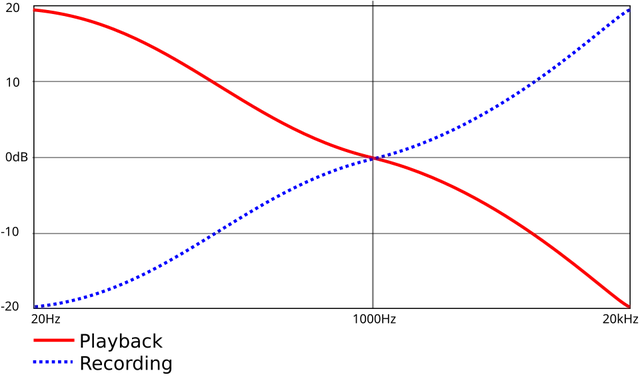
Uncommon card · Science
RIAA equalization, an Uncommon card
RIAA equalization is a specification for the recording and playback of phonograph records, established by the Recording Industry Association of America.
- Rarity
- Uncommon
- Domain
- Science
- ATK
- 65
- DEF
- 33
- Power
- 98
- Wikipedia reads a year
- 28,000
Power 98 (ATK + DEF): stronger than 40 % of WikiCards cards.
RIAA equalization quiz: 3 questions
Three questions on the RIAA equalization card, the way WikiCards duels ask them. Pick an answer, the facts are just below.
In which decade?
The RIAA equalization curve was intended to operate as a de facto global industry standard for records since ____, but when the change actually took place is difficult to determine.
Answer
1950s. The RIAA equalization curve was intended to operate as a de facto global industry standard for records since 1954, but when the change actually took place is difficult to determine. From the RIAA equalization article on Wikipedia.
Which of these cards hits hardest (highest ATK)?
Answer
Dirichlet's theorem on arithmetic progressions. Dirichlet's theorem on arithmetic progressions 68 · RIAA equalization 65 · Translation 60 · Diastereomer 56 ATK in WikiCards.
In a duel, each round asks a question like these about the opposing card, with 15 seconds to answer.
The facts on the card
The card carries these facts from its Wikipedia article.
- The purposes of the equalization are to permit greater recording times, to improve sound quality, and to reduce the groove damage that would otherwise arise during playback.
- The RIAA equalization curve was intended to operate as a de facto global industry standard for records since 1954, but when the change actually took place is difficult to determine.
- Before then, especially from 1940, each record company applied its own equalization, over 100 combinations of turnover and rolloff frequencies were in use, the main ones being Columbia-78, Decca-U.S., European, Victor-78, Associated, BBC, NAB, Orthacoustic, World, Columbia LP, FFRR-78 and microgroove, and AES.
Why it is Uncommon
Rarity in WikiCards follows a year of Wikipedia page views: the most read articles become Epic and Legendary cards. The RIAA equalization article was read about 28,000 times in a year. ATK comes from the length of the article and DEF from its quality, so this card hits with 65 and blocks with 33: each hit it takes is cut by 13 %.
How to get RIAA equalization
Open packs. Each pack holds five cards drawn from real Wikipedia articles, the rarest last, and the fifth card is always Rare or better. The odds are shown in the game. A free pack arrives every hour and two can wait, and the Coins you win in duels buy more packs.
More Science cards




Cards close in power
The cards just above and just below RIAA equalization in the power ranking, all domains together.
- TranslationUncommon · Science · ATK 60 DEF 38
- Bihari languagesUncommon · Society · ATK 59 DEF 39
- Brooke BrodackUncommon · Society · ATK 60 DEF 38
- Renault R26Uncommon · Society · ATK 60 DEF 38
- Arnaldur IndriðasonUncommon · Arts · ATK 55 DEF 43
- Belize Barrier ReefUncommon · Nature · ATK 55 DEF 43
Card lists
- Wikipedia quizNew questions every day
- All cards from A to ZEvery card, by name
- Science cards
- Legendary cards
- Tier listS and A tiers by power (ATK + DEF)
Credits
Text : Wikipedia, RIAA equalization (revision), CC BY-SA 4.0. Photo : Iainf 20:13, 27 July 2006 (UTC), Public domain, Wikimedia Commons.
