
 WikiCards
 Play on iPhone nowFree in Safari. Add it to your Home Screen.Play
WikiCards · Card list · Science cards · Giant-impact hypothesis
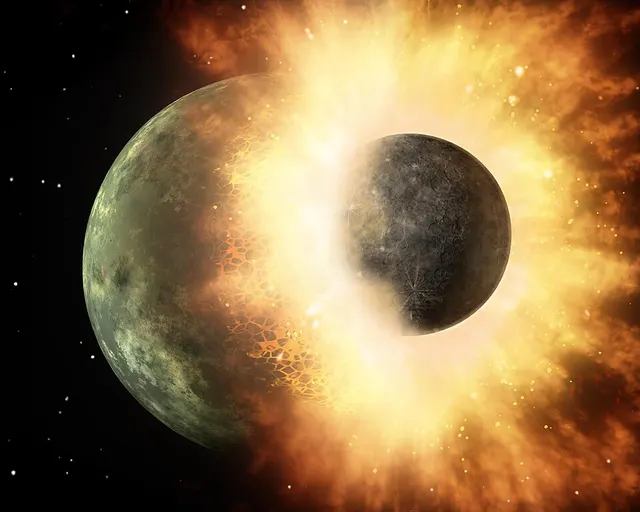
Uncommon card · Science
Giant-impact hypothesis, an Uncommon card
The giant-impact hypothesis, sometimes called the Theia Impact, is an astrogeology hypothesis for the formation of the Moon first proposed in 1946 by Canadian geologist Reginald Daly.
- Rarity
- Uncommon
- Domain
- Science
- ATK
- 79
- DEF
- 85
- Power
- 164
- Wikipedia reads a year
- 130,000
Power 164 (ATK + DEF): stronger than 85 % of WikiCards cards.
Giant-impact hypothesis quiz: 3 questions
Three questions on the Giant-impact hypothesis card, the way WikiCards duels ask them. Pick an answer, the facts are just below.
Find the missing word
The impactor planet is sometimes called Theia, named after the ______ Greek Titan who was the mother of Selene, the goddess of the Moon.
Answer
mythical. The impactor planet is sometimes called Theia, named after the mythical Greek Titan who was the mother of Selene, the goddess of the Moon. From the Giant-impact hypothesis article on Wikipedia.
In which decade?
The giant-impact hypothesis, sometimes called the Theia Impact, is an astrogeology hypothesis for the formation of the Moon first proposed in ____ by Canadian geologist Reginald Daly.
Answer
1940s. The giant-impact hypothesis, sometimes called the Theia Impact, is an astrogeology hypothesis for the formation of the Moon first proposed in 1946 by Canadian geologist Reginald Daly. From the Giant-impact hypothesis article on Wikipedia.
Which of these cards hits hardest (highest ATK)?
Answer
Bandung. Bandung 85 · Philo 82 · Giant-impact hypothesis 79 · Buckminsterfullerene 76 ATK in WikiCards.
In a duel, each round asks a question like these about the opposing card, with 15 seconds to answer.
The facts on the card
The card carries these facts from its Wikipedia article.
- The hypothesis suggests that the Proto-Earth collided with a Mars-sized co-orbital protoplanet likely from the L4 or L5 Lagrange points of the Earth's orbit approximately 4.5 billion years ago in the early Hadean eon, and some of the ejected debris from the impact event later re-accreted to form the Moon.
- The impactor planet is sometimes called Theia, named after the mythical Greek Titan who was the mother of Selene, the goddess of the Moon.
- Analysis of lunar rocks published in a 2016 report suggests that the impact might have been a direct hit, causing a fragmentation and thorough mixing of both parent bodies.
Why it is Uncommon
Rarity in WikiCards follows a year of Wikipedia page views: the most read articles become Epic and Legendary cards. The Giant-impact hypothesis article was read about 130,000 times in a year. ATK comes from the length of the article and DEF from its quality, so this card hits with 79 and blocks with 85: each hit it takes is cut by 34 %.
How to get Giant-impact hypothesis
Open packs. Each pack holds five cards drawn from real Wikipedia articles, the rarest last, and the fifth card is always Rare or better. The odds are shown in the game. A free pack arrives every hour and two can wait, and the Coins you win in duels buy more packs.
More Science cards



Cards close in power
The cards just above and just below Giant-impact hypothesis in the power ranking, all domains together.
- AmputationUncommon · Science · ATK 80 DEF 84
- BandungUncommon · Society · ATK 85 DEF 79
- CaliforniumUncommon · History · ATK 74 DEF 90
- Louise GlückUncommon · History · ATK 81 DEF 83
- Mark WaughUncommon · Society · ATK 84 DEF 80
- Maurice Jones-DrewUncommon · Society · ATK 82 DEF 82
Card lists
- Wikipedia quizNew questions every day
- All cards from A to ZEvery card, by name
- Science cards
- Legendary cards
- Tier listS and A tiers by power (ATK + DEF)
Credits
Text : Wikipedia, Giant-impact hypothesis (revision), CC BY-SA 4.0. Photo : NASA/JPL-Caltech, Public domain, Wikimedia Commons.
