
 WikiCards
 Play on iPhone nowFree in Safari. Add it to your Home Screen.Play
WikiCards · Card list · Science cards · Chinese remainder theorem
Uncommon card · Science
Chinese remainder theorem, an Uncommon card
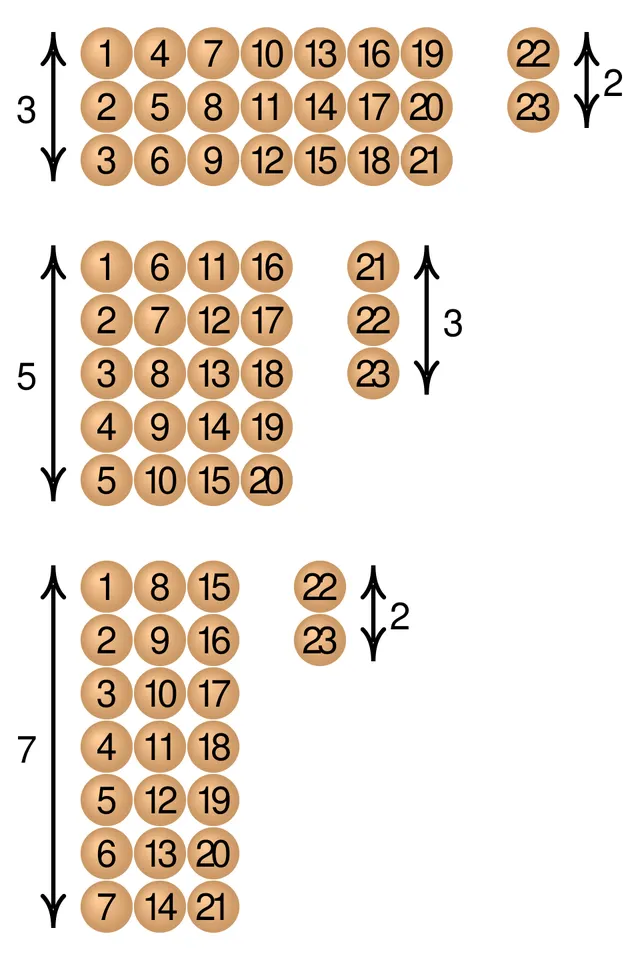
In mathematics, the Chinese remainder theorem states that if one knows the remainders of the Euclidean division of an integer n by several integers, then one can determine uniquely the remainder of the division of n by the product of these integers, under the condition that the divisors are pairwise coprime.
- Rarity
- Uncommon
- Domain
- Science
- ATK
- 74
- DEF
- 53
- Power
- 127
- Wikipedia reads a year
- 160,000
Power 127 (ATK + DEF): stronger than 60 % of WikiCards cards.
Chinese remainder theorem quiz: 3 questions
Three questions on the Chinese remainder theorem card, the way WikiCards duels ask them. Pick an answer, the facts are just below.
Find the missing word
The theorem is ______ called Sunzi's theorem.
Answer
sometimes. The theorem is sometimes called Sunzi's theorem. From the Chinese remainder theorem article on Wikipedia.
Which of these cards hits hardest (highest ATK)?
Answer
Chinese remainder theorem. Chinese remainder theorem 74 · Solar eclipse of August 2, 2027 69 · Cape Canaveral 66 · List of United States post offices in Massachusetts 63 ATK in WikiCards.
Which of these Wikipedia articles is read the most in a year?
Answer
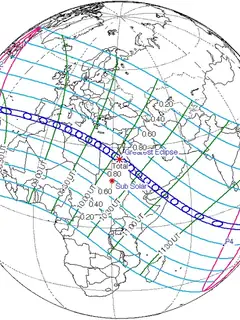
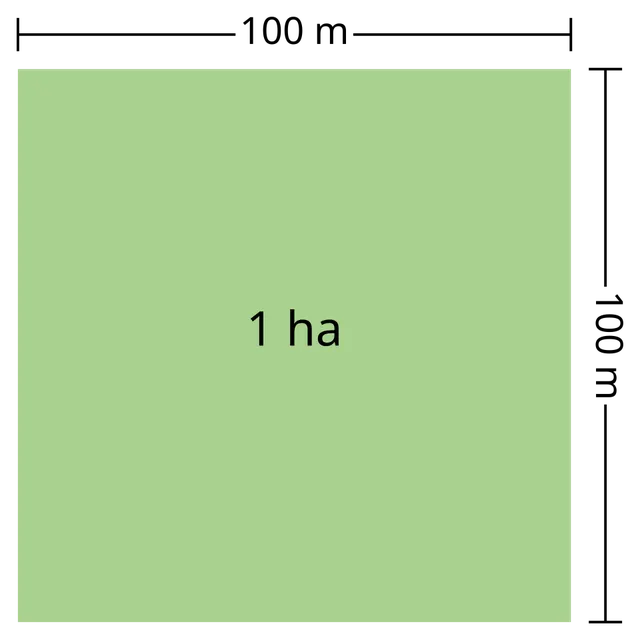
Solar eclipse of August 2, 2027. Solar eclipse of August 2, 2027 640,000 · Hectare 220,000 · Chinese remainder theorem 160,000 · List of United States post offices in Massachusetts 310 Wikipedia reads over a year.
In a duel, each round asks a question like these about the opposing card, with 15 seconds to answer.
The facts on the card
The card carries these facts from its Wikipedia article.
- The theorem is sometimes called Sunzi's theorem.
- Both names of the theorem refer to its earliest known statement that appeared in Sunzi Suanjing, a Chinese manuscript written during the 3rd to 5th century CE.
- This first statement was restricted to the following example: If one knows that the remainder of n divided by 3 is 2, the remainder of n divided by 5 is 3, and the remainder of n divided by 7 is 2, then with no other information, one can determine the remainder of n divided by 105 without knowing the value of n.
Why it is Uncommon
Rarity in WikiCards follows a year of Wikipedia page views: the most read articles become Epic and Legendary cards. The Chinese remainder theorem article was read about 160,000 times in a year. ATK comes from the length of the article and DEF from its quality, so this card hits with 74 and blocks with 53: each hit it takes is cut by 21 %.
How to get Chinese remainder theorem
Open packs. Each pack holds five cards drawn from real Wikipedia articles, the rarest last, and the fifth card is always Rare or better. The odds are shown in the game. A free pack arrives every hour and two can wait, and the Coins you win in duels buy more packs.
More Science cards




Cards close in power
The cards just above and just below Chinese remainder theorem in the power ranking, all domains together.
- AcrophobiaUncommon · Science · ATK 71 DEF 56
- Adagio for StringsUncommon · Arts · ATK 69 DEF 58
- CaltropUncommon · Arts · ATK 64 DEF 63
- BowlsUncommon · Society · ATK 69 DEF 58
- Cape CanaveralUncommon · Nature · ATK 66 DEF 61
- PP-19 BizonUncommon · History · ATK 62 DEF 65
Card lists
- Wikipedia quizNew questions every day
- All cards from A to ZEvery card, by name
- Science cards
- Legendary cards
- Tier listS and A tiers by power (ATK + DEF)
Credits
Text : Wikipedia, Chinese remainder theorem (revision), CC BY-SA 4.0. Photo : Cmglee, CC BY-SA 4.0, Wikimedia Commons.
