
 WikiCards
 Play on iPhone nowFree in Safari. Add it to your Home Screen.Play
WikiCards · Card list · Science cards · An Essay on the Principle of Population
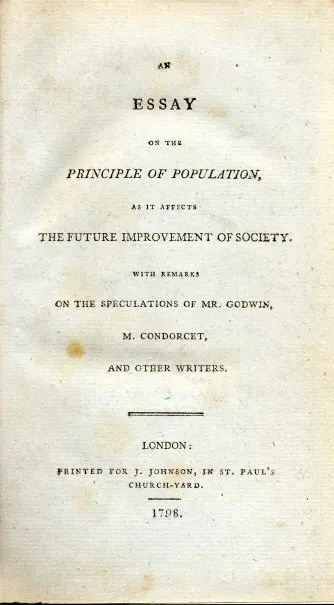
Uncommon card · Science
An Essay on the Principle of Population, an Uncommon card
The book An Essay on the Principle of Population was first published anonymously in 1798, but the author was soon identified as Thomas Robert Malthus.
- Rarity
- Uncommon
- Domain
- Science
- ATK
- 80
- DEF
- 67
- Power
- 147
- Wikipedia reads a year
- 30,000
Power 147 (ATK + DEF): stronger than 75 % of WikiCards cards.
An Essay on the Principle of Population quiz: 3 questions
Three questions on the An Essay on the Principle of Population card, the way WikiCards duels ask them. Pick an answer, the facts are just below.
In which decade?
The book An Essay on the Principle of Population was first published anonymously in ____, but the author was soon identified as Thomas Robert Malthus.
Answer
1790s. The book An Essay on the Principle of Population was first published anonymously in 1798, but the author was soon identified as Thomas Robert Malthus. From the An Essay on the Principle of Population article on Wikipedia.
Which of these cards hits hardest (highest ATK)?
Answer
Anti–money laundering. Anti–money laundering 87 · An Essay on the Principle of Population 80 · No-till farming 74 · Acrux 70 ATK in WikiCards.
In a duel, each round asks a question like these about the opposing card, with 15 seconds to answer.
The facts on the card
The card carries these facts from its Wikipedia article.
- The book warned of future difficulties, on an interpretation of the population increasing in geometric progression while food production increased in an arithmetic progression, which would leave a difference resulting in the want of food and famine, unless birth rates decreased.
- While it was not the first book on population, Malthus's book fuelled debate about the size of the population in Britain and contributed to the passing of the Census Act 1800.
- This Act enabled the holding of a national census in England, Wales and Scotland, starting in 1801 and continuing every ten years to the present.
Why it is Uncommon
Rarity in WikiCards follows a year of Wikipedia page views: the most read articles become Epic and Legendary cards. The An Essay on the Principle of Population article was read about 30,000 times in a year. ATK comes from the length of the article and DEF from its quality, so this card hits with 80 and blocks with 67: each hit it takes is cut by 27 %.
How to get An Essay on the Principle of Population
Open packs. Each pack holds five cards drawn from real Wikipedia articles, the rarest last, and the fifth card is always Rare or better. The odds are shown in the game. A free pack arrives every hour and two can wait, and the Coins you win in duels buy more packs.
More Science cards







Cards close in power
The cards just above and just below An Essay on the Principle of Population in the power ranking, all domains together.
- The Wizard of OzUncommon · Arts · ATK 77 DEF 70
- Dickinson, North DakotaUncommon · Society · ATK 74 DEF 73
- Museu Nacional d'Art de CatalunyaUncommon · Arts · ATK 80 DEF 67
- Arthur HoneggerUncommon · Arts · ATK 78 DEF 69
- Khaltmaagiin BattulgaUncommon · History · ATK 72 DEF 75
- Dall's porpoiseUncommon · Nature · ATK 66 DEF 81
Card lists
- Wikipedia quizNew questions every day
- All cards from A to ZEvery card, by name
- Science cards
- Legendary cards
- Tier listS and A tiers by power (ATK + DEF)
Credits
Text : Wikipedia, An Essay on the Principle of Population (revision), CC BY-SA 4.0. Photo : The original uploader was Lupo at English Wikipedia ., Public domain, Wikimedia Commons.
