 WikiCards
 Play on iPhone nowFree in Safari. Add it to your Home Screen.Play
WikiCards · Card list · Science cards · Pleiades
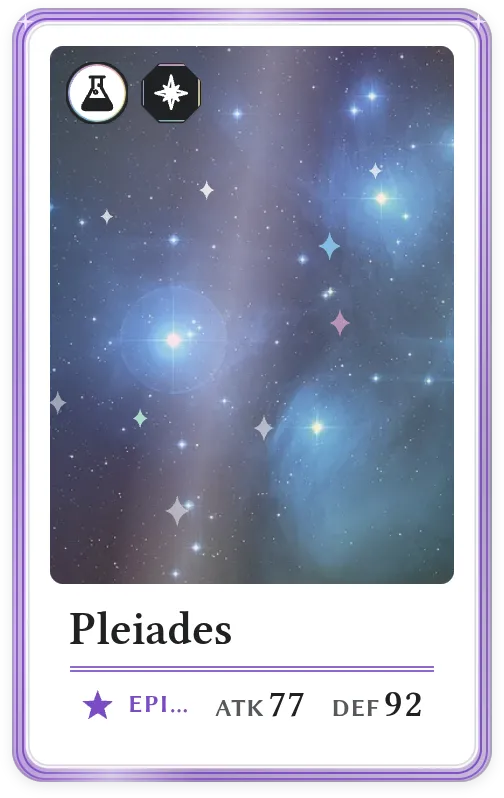
Epic card · Science
Pleiades, an Epic card
The Pleiades, also known as Seven Sisters and Messier 45, is an asterism of an open star cluster containing young B-type stars in the northwest of the constellation Taurus.
- Rarity
- Epic
- Domain
- Science
- ATK
- 77
- DEF
- 92
- Power
- 169
- Wikipedia reads a year
- 510,000
Ranked #1094 of 3,000 cards by power (ATK + DEF) in the base set.
The facts on the card
The card carries these facts from its Wikipedia article.
- At a distance of about 444 light-years, it is among the star clusters nearest to Earth and is the Messier object nearest to Earth, being the star cluster most obvious to the naked eye in the night sky.
- It contains over 1,000 stars, with the brightest six or seven being easily visible to the naked eye.
- The Pleiades cluster contains the reflection nebulae NGC 1432, an HII region, and NGC 1435, known as the Merope Nebula.
Why it is Epic
Rarity in WikiCards follows a year of Wikipedia page views: the most read articles become Epic and Legendary cards. The Pleiades article was read about 510,000 times in a year. ATK comes from the length of the article and DEF from its quality, so this card hits with 77 and blocks with 92: each hit it takes is cut by 37 %.
How to get Pleiades
Open packs. Each pack holds five cards drawn from real Wikipedia articles, the rarest last, and the fifth card is always Rare or better. The odds are shown in the game. A free pack arrives every 3 hours, and the Coins you win in duels buy more packs.
More Science cards
Card lists
- Nature cards600 cards
- Science cards600 cards
- History cards600 cards
- Arts cards600 cards
- Society cards600 cards
- Tier listS and A tiers by power (ATK + DEF)
- Legendary cards132 cards
- Epic cards263 cards
- Strongest cardsTop 100 by attack
Credits
Text : Wikipedia, Pleiades (revision), CC BY-SA 4.0. Photo : NASA, ESA, AURA/Caltech, Palomar Observatory The science team consists of: D. Soderblom an, Public domain, Wikimedia Commons.
