 WikiCards
 Play on iPhone nowFree in Safari. Add it to your Home Screen.Play
WikiCards · Card list · Science cards · Cirrhosis
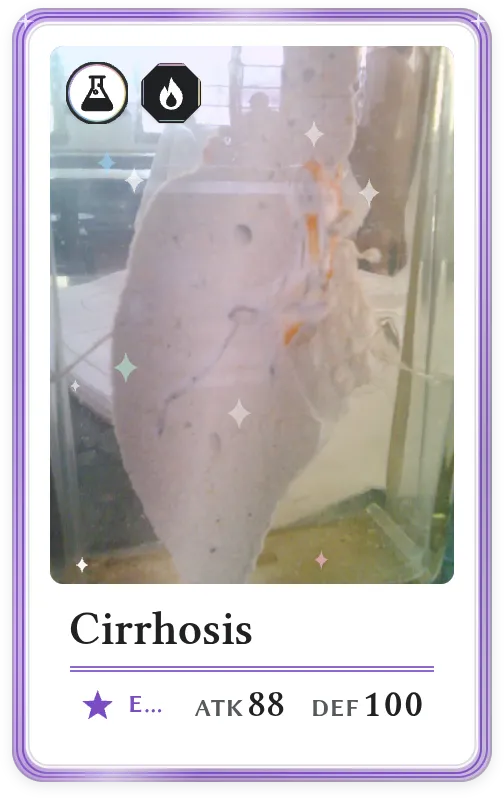
Epic card · Science
Cirrhosis, an Epic card
Cirrhosis, also known as liver cirrhosis, hepatic cirrhosis, chronic liver failure, chronic hepatic failure, and end-stage liver disease, is a chronic condition of the liver in which the normal functioning tissue, or parenchyma, is replaced with scar tissue and regenerative nodules as a result of chronic liver disease.
- Rarity
- Epic
- Domain
- Science
- ATK
- 88
- DEF
- 100
- Power
- 188
- Wikipedia reads a year
- 670,000
Ranked #184 of 3,000 cards by power (ATK + DEF) in the base set.
The facts on the card
The card carries these facts from its Wikipedia article.
- Damage to the liver leads to repair of liver tissue and subsequent formation of scar tissue.
- Over time, scar tissue and nodules of regenerating hepatocytes can replace the parenchyma, causing increased resistance to blood flow in the liver's capillaries, the hepatic sinusoids, and consequently portal hypertension, as well as impairment in other aspects of liver function.
- The disease typically develops slowly over months or years.
Why it is Epic
Rarity in WikiCards follows a year of Wikipedia page views: the most read articles become Epic and Legendary cards. The Cirrhosis article was read about 670,000 times in a year. ATK comes from the length of the article and DEF from its quality, so this card hits with 88 and blocks with 100: each hit it takes is cut by 40 %.
How to get Cirrhosis
Open packs. Each pack holds five cards drawn from real Wikipedia articles, the rarest last, and the fifth card is always Rare or better. The odds are shown in the game. A free pack arrives every 3 hours, and the Coins you win in duels buy more packs.
More Science cards





Card lists
- Nature cards600 cards
- Science cards600 cards
- History cards600 cards
- Arts cards600 cards
- Society cards600 cards
- Tier listS and A tiers by power (ATK + DEF)
- Legendary cards132 cards
- Epic cards263 cards
- Strongest cardsTop 100 by attack
Credits
Text : Wikipedia, Cirrhosis (revision), CC BY-SA 4.0. Photo : Netha Hussain, CC BY-SA 3.0, Wikimedia Commons.
