
 WikiCards
 Play on iPhone nowFree in Safari. Add it to your Home Screen.Play
WikiCards · Card list · Arts cards · International Covenant on Economic, Social and Cultural Rights
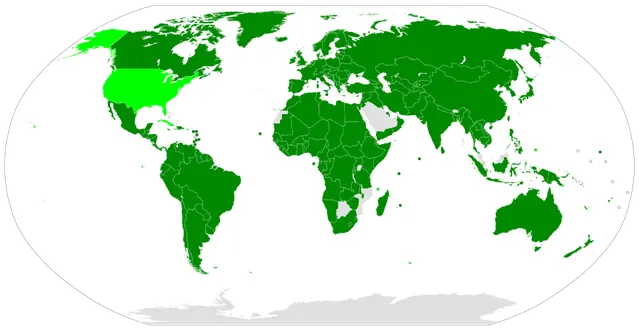
Uncommon card · Arts
International Covenant on Economic, Social and Cultural Rights, an Uncommon card
The International Covenant on Economic, Social and Cultural Rights is a multilateral treaty adopted by the United Nations General Assembly on 16 December 1966 through GA.
- Rarity
- Uncommon
- Domain
- Arts
- ATK
- 79
- DEF
- 80
- Power
- 159
- Wikipedia reads a year
- 36,000
Power 159 (ATK + DEF): stronger than 80 % of WikiCards cards.
International Covenant on Economic, Social and Cultural Rights quiz: 3 questions
Three questions on the International Covenant on Economic, Social and Cultural Rights card, the way WikiCards duels ask them. Pick an answer, the facts are just below.
Find the missing word
Resolution 2200A, and came into force on 3 ______ 1976.
Answer
January. Resolution 2200A, and came into force on 3 January 1976. From the International Covenant on Economic, Social and Cultural Rights article on Wikipedia.
In which decade?
The International Covenant on Economic, Social and Cultural Rights is a multilateral treaty adopted by the United Nations General Assembly on 16 December ____ through GA.
Answer
1960s. The International Covenant on Economic, Social and Cultural Rights is a multilateral treaty adopted by the United Nations General Assembly on 16 December 1966 through GA. From the International Covenant on Economic, Social and Cultural Rights article on Wikipedia.
Which of these cards hits hardest (highest ATK)?
Answer
TWS. TWS 84 · International Covenant on Economic, Social and Cultural Rights 79 · Henri de Toulouse-Lautrec 76 · Church of St Michael and All Angels, Beckwithshaw 72 ATK in WikiCards.
In a duel, each round asks a question like these about the opposing card, with 15 seconds to answer.
The facts on the card
The card carries these facts from its Wikipedia article.
- Resolution 2200A, and came into force on 3 January 1976.
- It commits its parties to work toward the granting of economic, social, and cultural rights to all individuals including those living in Non-Self-Governing and Trust Territories.
- The rights include labour rights, the right to health, the right to education, and the right to an adequate standard of living.
Why it is Uncommon
Rarity in WikiCards follows a year of Wikipedia page views: the most read articles become Epic and Legendary cards. The International Covenant on Economic, Social and Cultural Rights article was read about 36,000 times in a year. ATK comes from the length of the article and DEF from its quality, so this card hits with 79 and blocks with 80: each hit it takes is cut by 32 %.
How to get International Covenant on Economic, Social and Cultural Rights
Open packs. Each pack holds five cards drawn from real Wikipedia articles, the rarest last, and the fifth card is always Rare or better. The odds are shown in the game. A free pack arrives every hour and two can wait, and the Coins you win in duels buy more packs.
More Arts cards






Cards close in power
The cards just above and just below International Covenant on Economic, Social and Cultural Rights in the power ranking, all domains together.
- ZoningUncommon · Society · ATK 84 DEF 75
- Šuppiluliuma IUncommon · History · ATK 74 DEF 85
- Smoke grenadeUncommon · Science · ATK 80 DEF 79
- Southend PierUncommon · Society · ATK 73 DEF 86
- Bidar districtUncommon · Society · ATK 76 DEF 83
- Inverness-shireUncommon · History · ATK 76 DEF 83
Card lists
- Wikipedia quizNew questions every day
- All cards from A to ZEvery card, by name
- Arts cards
- Legendary cards
- Tier listS and A tiers by power (ATK + DEF)
Credits
Text : Wikipedia, International Covenant on Economic, Social and Cultural Rights (revision), CC BY-SA 4.0. Photo : User:Louperivois, CC BY-SA 4.0, Wikimedia Commons.
