 WikiCards
 Play on iPhone nowFree in Safari. Add it to your Home Screen.Play
WikiCards · Card list · Science cards · Galaxy
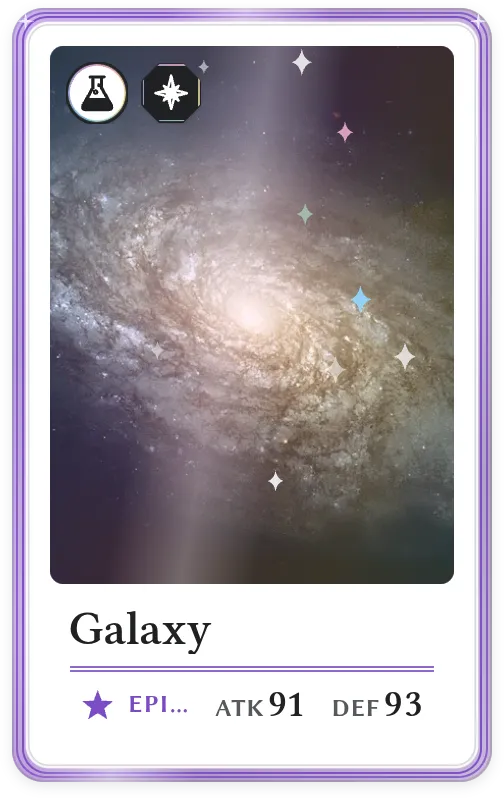
Epic card · Science
Galaxy, an Epic card
A galaxy is a physical system of stars, planetary systems, stellar remnants, substellar objects, interstellar gas, dust, and dark matter bound together by gravity.
- Rarity
- Epic
- Domain
- Science
- ATK
- 91
- DEF
- 93
- Power
- 184
- Wikipedia reads a year
- 560,000
Ranked #365 of 3,000 cards by power (ATK + DEF) in the base set.
The facts on the card
The card carries these facts from its Wikipedia article.
- The word is derived from the Greek galaxias, meaning 'milky', a reference to the Milky Way galaxy that contains the Solar System.
- Galaxies, averaging an estimated 100 million stars, range in size from dwarfs with less than a thousand stars to the largest galaxies known, supergiants with one hundred trillion stars, each orbiting its galaxy's center of mass.
- Most of the mass in a typical galaxy is in the form of dark matter, with only a few percent of that mass visible in the form of stars and nebulae.
Why it is Epic
Rarity in WikiCards follows a year of Wikipedia page views: the most read articles become Epic and Legendary cards. The Galaxy article was read about 560,000 times in a year. ATK comes from the length of the article and DEF from its quality, so this card hits with 91 and blocks with 93: each hit it takes is cut by 37 %.
How to get Galaxy
Open packs. Each pack holds five cards drawn from real Wikipedia articles, the rarest last, and the fifth card is always Rare or better. The odds are shown in the game. A free pack arrives every 3 hours, and the Coins you win in duels buy more packs.
More Science cards






Card lists
- Nature cards600 cards
- Science cards600 cards
- History cards600 cards
- Arts cards600 cards
- Society cards600 cards
- Tier listS and A tiers by power (ATK + DEF)
- Legendary cards132 cards
- Epic cards263 cards
- Strongest cardsTop 100 by attack
Credits
Text : Wikipedia, Galaxy (revision), CC BY-SA 4.0. Photo : The Hubble Heritage Team (AURA/STScI/NASA) NASA Headquarters - Greatest Images of NASA (NA, Public domain, Wikimedia Commons.
.jpg)