 WikiCards
 Play on iPhone nowFree in Safari. Add it to your Home Screen.Play
WikiCards · Card list · Science cards · Big Bang
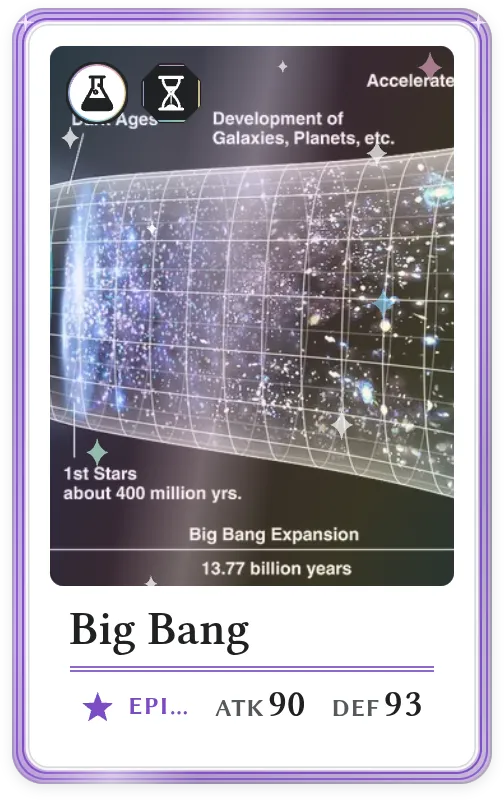
Epic card · Science
Big Bang, an Epic card
The Big Bang is a physical theory that describes how the universe expanded from an early state of high density and temperature.
- Rarity
- Epic
- Domain
- Science
- ATK
- 90
- DEF
- 93
- Power
- 183
- Wikipedia reads a year
- 950,000
Ranked #420 of 3,000 cards by power (ATK + DEF) in the base set.
The facts on the card
The card carries these facts from its Wikipedia article.
- Various cosmological models based on the Big Bang concept explain a broad range of phenomena, including the abundance of light elements, the cosmic microwave background radiation, the redshift of galaxies and the large-scale structure of the universe.
- The observed uniformity of the universe, which leads to the horizon and flatness problems, is explained through cosmic inflation: a phase of accelerated expansion during the earliest stages.
- Detailed measurements of the expansion rate of the universe place the cosmic inflation at an estimated 13.787±0.02 billion years ago, which is considered the age of the universe.
Why it is Epic
Rarity in WikiCards follows a year of Wikipedia page views: the most read articles become Epic and Legendary cards. The Big Bang article was read about 950,000 times in a year. ATK comes from the length of the article and DEF from its quality, so this card hits with 90 and blocks with 93: each hit it takes is cut by 37 %.
How to get Big Bang
Open packs. Each pack holds five cards drawn from real Wikipedia articles, the rarest last, and the fifth card is always Rare or better. The odds are shown in the game. A free pack arrives every 3 hours, and the Coins you win in duels buy more packs.
More Science cards




Card lists
- Nature cards600 cards
- Science cards600 cards
- History cards600 cards
- Arts cards600 cards
- Society cards600 cards
- Tier listS and A tiers by power (ATK + DEF)
- Legendary cards132 cards
- Epic cards263 cards
- Strongest cardsTop 100 by attack
Credits
Text : Wikipedia, Big Bang (revision), CC BY-SA 4.0. Photo : NASA/WMAP Science Team, Public domain, Wikimedia Commons.
