 WikiCards
 Play on iPhone nowFree in Safari. Add it to your Home Screen.Play
WikiCards · Card list · History cards · Machu Picchu
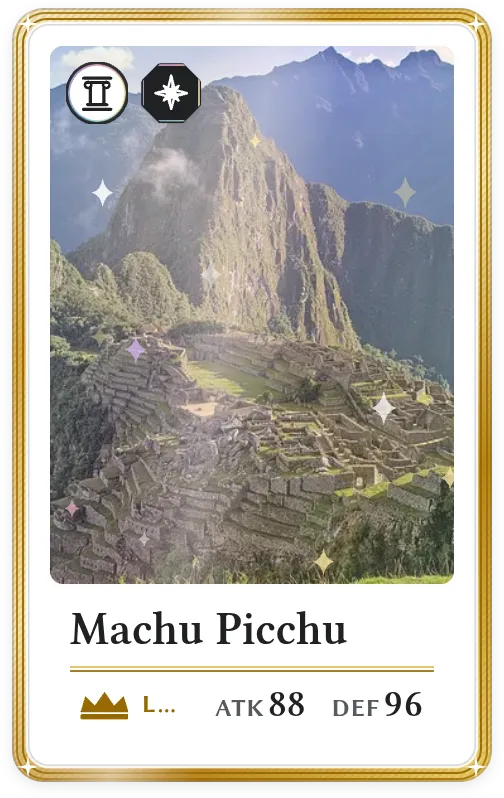
Legendary card · History
Machu Picchu, a Legendary card
Machu Picchu is a 15th-century Inca citadel located in the Eastern Cordillera of southern Peru on a mountain ridge at 2,430 meters.
- Rarity
- Legendary
- Domain
- History
- ATK
- 88
- DEF
- 96
- Power
- 184
- Wikipedia reads a year
- 1,200,000
Ranked #353 of 3,000 cards by power (ATK + DEF) in the base set.
The facts on the card
The card carries these facts from its Wikipedia article.
- It is situated in the Machupicchu District of Urubamba Province about 80 kilometers northwest of Cusco, above the Sacred Valley and along the Urubamba River, which forms a deep canyon with a subtropical mountain climate.
- Often referred to as the "Lost City of the Incas", Machu Picchu is one of the most iconic symbols of the Inca civilization and a major archaeological site in the Americas.
- Estimated to be built around 1450, it is believed to have served as an estate for the Inca emperor Pachacuti, though no contemporary written records exist to confirm this.
Why it is Legendary
Rarity in WikiCards follows a year of Wikipedia page views: the most read articles become Epic and Legendary cards. The Machu Picchu article was read about 1,200,000 times in a year. ATK comes from the length of the article and DEF from its quality, so this card hits with 88 and blocks with 96: each hit it takes is cut by 38 %.
How to get Machu Picchu
Open packs. Each pack holds five cards drawn from real Wikipedia articles, the rarest last, and the fifth card is always Rare or better. The odds are shown in the game. A free pack arrives every 3 hours, and the Coins you win in duels buy more packs.
More History cards



Card lists
- Nature cards600 cards
- Science cards600 cards
- History cards600 cards
- Arts cards600 cards
- Society cards600 cards
- Tier listS and A tiers by power (ATK + DEF)
- Legendary cards132 cards
- Epic cards263 cards
- Strongest cardsTop 100 by attack
Credits
Text : Wikipedia, Machu Picchu (revision), CC BY-SA 4.0. Photo : Draceane, CC BY-SA 4.0, Wikimedia Commons.
.jpg)