 WikiCards
 Play on iPhone nowFree in Safari. Add it to your Home Screen.Play
WikiCards · Card list · History cards · Atomic bombings of Hiroshima and Nagasaki
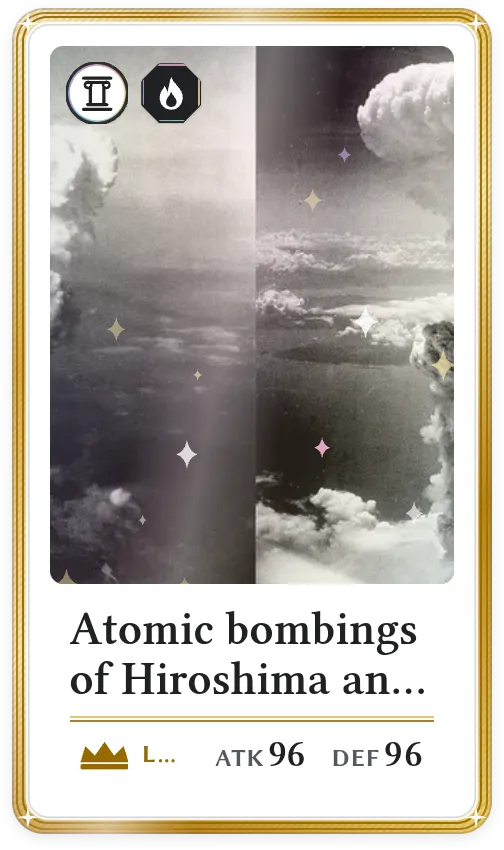
Legendary card · History
Atomic bombings of Hiroshima and Nagasaki, a Legendary card
On 6 and 9 August 1945, the United States detonated two atomic bombs over the Japanese cities of Hiroshima and Nagasaki, respectively, during the final days of World War II.
- Rarity
- Legendary
- Domain
- History
- ATK
- 96
- DEF
- 96
- Power
- 192
- Wikipedia reads a year
- 2,700,000
Ranked #59 of 3,000 cards by power (ATK + DEF) in the base set.
The facts on the card
The card carries these facts from its Wikipedia article.
- The aerial bombings killed 150,000 to 246,000 people, most of whom were civilians, and remain the first and only uses of nuclear weapons in an armed conflict.
- In the final year of World War II, the Allies prepared for a costly invasion of the Japanese mainland.
- This undertaking was preceded by a conventional bombing and firebombing campaign that devastated 64 Japanese cities, including an operation on Tokyo.
Why it is Legendary
Rarity in WikiCards follows a year of Wikipedia page views: the most read articles become Epic and Legendary cards. The Atomic bombings of Hiroshima and Nagasaki article was read about 2,700,000 times in a year. ATK comes from the length of the article and DEF from its quality, so this card hits with 96 and blocks with 96: each hit it takes is cut by 38 %.
How to get Atomic bombings of Hiroshima and Nagasaki
Open packs. Each pack holds five cards drawn from real Wikipedia articles, the rarest last, and the fifth card is always Rare or better. The odds are shown in the game. A free pack arrives every 3 hours, and the Coins you win in duels buy more packs.
More History cards




Card lists
- Nature cards600 cards
- Science cards600 cards
- History cards600 cards
- Arts cards600 cards
- Society cards600 cards
- Tier listS and A tiers by power (ATK + DEF)
- Legendary cards132 cards
- Epic cards263 cards
- Strongest cardsTop 100 by attack
Credits
Text : Wikipedia, Atomic bombings of Hiroshima and Nagasaki (revision), CC BY-SA 4.0. Photo : George R. Caron / Charles Levy, Public domain, Wikimedia Commons.
