 WikiCards
 Play on iPhone nowFree in Safari. Add it to your Home Screen.Play
WikiCards · Card list · Society cards · Zoroastrianism
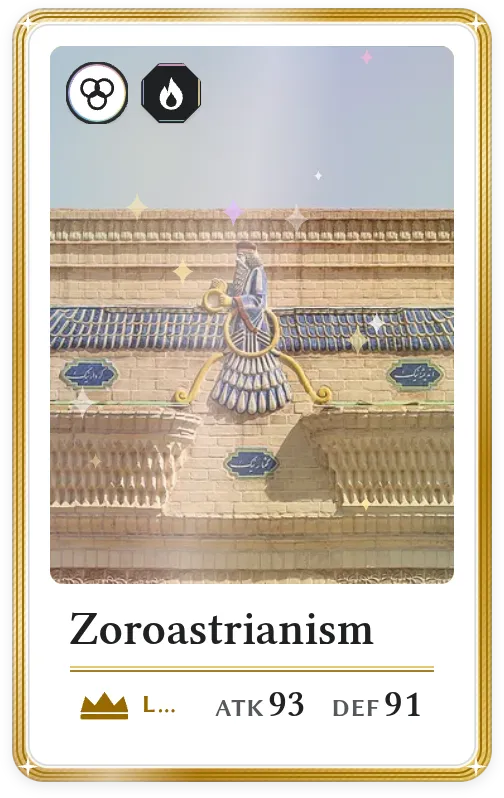
Legendary card · Society
Zoroastrianism, a Legendary card
Zoroastrianism, also called Mazdayasna and Behdin, is an Iranian religion centred on the Avesta and the teachings of Zarathushtra Spitama, who is more commonly referred to by the Greek translation, Zoroaster.
- Rarity
- Legendary
- Domain
- Society
- ATK
- 93
- DEF
- 91
- Power
- 184
- Wikipedia reads a year
- 2,100,000
Ranked #351 of 3,000 cards by power (ATK + DEF) in the base set.
The facts on the card
The card carries these facts from its Wikipedia article.
- Among the world's oldest organized faiths, its adherents exalt an uncreated, benevolent, and all-wise deity known as Ahura Mazda, who is hailed as the supreme being of the universe.
- In the foundational hymns of Zoroastrianism, the Gathas, the primary dualism is ethical and psychological rather than cosmic, centred on the choice between Asha and Druj.
- Within this early theological framework, Ahura Mazda is the supreme, transcendent Creator who stands above the conflict.
Why it is Legendary
Rarity in WikiCards follows a year of Wikipedia page views: the most read articles become Epic and Legendary cards. The Zoroastrianism article was read about 2,100,000 times in a year. ATK comes from the length of the article and DEF from its quality, so this card hits with 93 and blocks with 91: each hit it takes is cut by 36 %.
How to get Zoroastrianism
Open packs. Each pack holds five cards drawn from real Wikipedia articles, the rarest last, and the fifth card is always Rare or better. The odds are shown in the game. A free pack arrives every 3 hours, and the Coins you win in duels buy more packs.
More Society cards








Card lists
- Nature cards600 cards
- Science cards600 cards
- History cards600 cards
- Arts cards600 cards
- Society cards600 cards
- Tier listS and A tiers by power (ATK + DEF)
- Legendary cards132 cards
- Epic cards263 cards
- Strongest cardsTop 100 by attack
Credits
Text : Wikipedia, Zoroastrianism (revision), CC BY-SA 4.0. Photo : Bernard Gagnon, CC BY-SA 4.0, Wikimedia Commons.
