 WikiCards
 Play on iPhone nowFree in Safari. Add it to your Home Screen.Play
WikiCards · Card list · Nature cards · Sahara
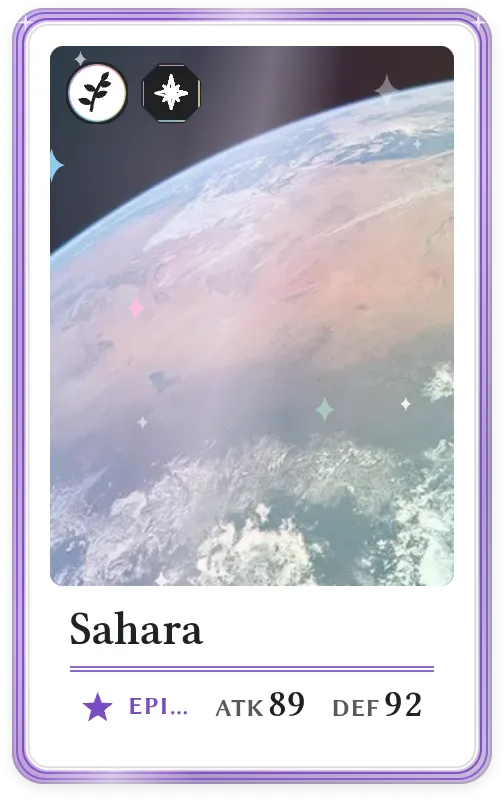
Epic card · Nature
Sahara, an Epic card
The Sahara is a desert spanning North Africa. With an area of 9,200,000 square kilometres, it is the largest hot desert in the world and the third-largest desert overall, smaller only than the deserts of Antarctica and the northern Arctic.
- Rarity
- Epic
- Domain
- Nature
- ATK
- 89
- DEF
- 92
- Power
- 181
- Wikipedia reads a year
- 570,000
Ranked #536 of 3,000 cards by power (ATK + DEF) in the base set.
The facts on the card
The card carries these facts from its Wikipedia article.
- The desert covers much of North Africa, excluding the fertile region on the Mediterranean Sea coast, the Atlas Mountains of the Maghreb, and the Nile Valley in Egypt and the Sudan.
- It stretches from the Red Sea in the east and the Mediterranean in the north to the Atlantic Ocean in the west, where the landscape gradually changes from desert to coastal plains.
- To the south it is bounded by the Sahel, a belt of semi-arid tropical savanna around the Niger River valley and the Sudan region of sub-Saharan Africa.
Why it is Epic
Rarity in WikiCards follows a year of Wikipedia page views: the most read articles become Epic and Legendary cards. The Sahara article was read about 570,000 times in a year. ATK comes from the length of the article and DEF from its quality, so this card hits with 89 and blocks with 92: each hit it takes is cut by 37 %.
How to get Sahara
Open packs. Each pack holds five cards drawn from real Wikipedia articles, the rarest last, and the fifth card is always Rare or better. The odds are shown in the game. A free pack arrives every 3 hours, and the Coins you win in duels buy more packs.
More Nature cards


Card lists
- Nature cards600 cards
- Science cards600 cards
- History cards600 cards
- Arts cards600 cards
- Society cards600 cards
- Tier listS and A tiers by power (ATK + DEF)
- Legendary cards132 cards
- Epic cards263 cards
- Strongest cardsTop 100 by attack
Credits
Text : Wikipedia, Sahara (revision), CC BY-SA 4.0. Photo : Project Apollo Archive, Public domain, Wikimedia Commons.
